I build AI products that make complex systems usable.
Four builds are on this site, covering household utility bills, model selection, investor research, and LLM evaluation.
I am looking for an AI product role where strategy, technical judgment, and real user consequences meet.
Present day · 2026
Chronology begins
I began in civil engineering.At NJIT, engineering management—and electives in analytics and software engineering—became my bridge into technology.From 2017 through mid-2024, I built cloud and data systems across two regulated client environments,co-founded a technology consulting company,and used business school to move closer to product, venture capital, and applied AI.The disciplines meet now, in the work I build.
2014–2016Engineering
Civil engineering taught me to read systems. Engineering management opened the path into software.
At NJIT, analytics and software-engineering electives turned that systems mindset toward technology. The underlying questions stayed familiar: how complex systems are specified, connected, tested, and trusted.
I completed a BTech in Civil Engineering at GITAM in 2014, then an MS in Engineering Management at NJIT in 2016. At NJIT, electives in analytics and software engineering gave me a practical route into technology. The domain changed, but the systems thinking carried forward: understanding dependencies, finding failure points, and building structures people could rely on.
Single track. One discipline, learned as a way of reading systems.
2014BTech Civil Engineering, GITAM.
2016MS Engineering Management, NJIT.
2017–2024Hexaware TechnologiesEmployer
From 2017 through mid-2024, I worked across two regulated client environments where what we built had to remain explainable later.
One employer, two sequential client environments: Fannie Mae, then Rite Aid. Mostly AWS. The organizations ran machine learning; I was helping build the data foundations beneath it.
In April 2017 I joined Hexaware Technologies and was placed on the Fannie Mae account, where I spent five and a half years as a software technology consultant. Hexaware was my employer; Fannie Mae was the environment I worked in. Consulting into a regulated institution teaches a particular discipline, because everything you build has to be explainable later.
Most of that work was on AWS. For a stretch I sat on the data mart team, building and testing the ETL that fed the business intelligence teams, bringing structured and unstructured sources into a shape people could work with. The organization ran machine learning. I was not building models. I was helping build the data foundation beneath them.
In 2021, still on the account, I completed a master's in information technology at the University of the Cumberlands while working full time. It was the first stretch where what I studied and what I did all day pointed the same direction.
One employment spine. Client accounts sit inside it; a founder track starts inside it too.
2017–2022Client accountFannie Mae — software technology consultant. AWS, data marts, and the ETL feeding downstream BI and ML teams.
2021MS Information Technology, University of the Cumberlands — completed while working full time.
2023–mid-2024Client accountRite Aid — lead software consultant. Pharmacy operations, AWS, ML-enabled operational workflows in another regulated environment.
2022–2024The TekWinn CompanyConcurrent
A consulting company built alongside the full-time role. $1.8M revenue by 2024.
Founding partner and product lead, built while the Hexaware employment continued — this track overlaps the last two years of that spine, it does not replace it.
In January 2022 I co-founded The TekWinn Company as founding partner and product lead. It was a technology consulting company that I developed while continuing my full-time role at Hexaware. By the time I stepped away in 2024, TekWinn had generated $1.8 million in revenue.
A year into that, Hexaware moved me to the Rite Aid account as lead software consultant: pharmacy operations across a distributed network, ML automation on AWS, another regulated environment. It moved me closer to ML-enabled operational workflows rather than only the infrastructure beneath them.
In July 2024 I left both to start the MBA full time. I had been circling business school for a while and wanted to give it my whole attention.
Two tracks run at once. Neither replaced the other.
Concurrency
Two tracks, one period — then they converge.
201720192021202320252027
Employment
Founder
Education
Product · venture
Bars are drawn from the dated record. Where they overlap, the work overlapped. The 2021 marker is a completion date, not a duration claim.
2024–2026The bridge
An MBA is usually described as a pivot. Mine was closer to a bridge.
Kenan-Flagler added product judgment, deeper commercial reasoning, a venture perspective, and repeated practice moving ideas between technical and business audiences.
I arrived with seven years of systems and data work and two years of running a company. Kenan-Flagler added product judgment, deeper commercial reasoning, a venture perspective, and repeated practice moving ideas between technical and business audiences without losing them along the way. Both chapters below happened inside those two years.
2026MBA, UNC Kenan-Flagler.
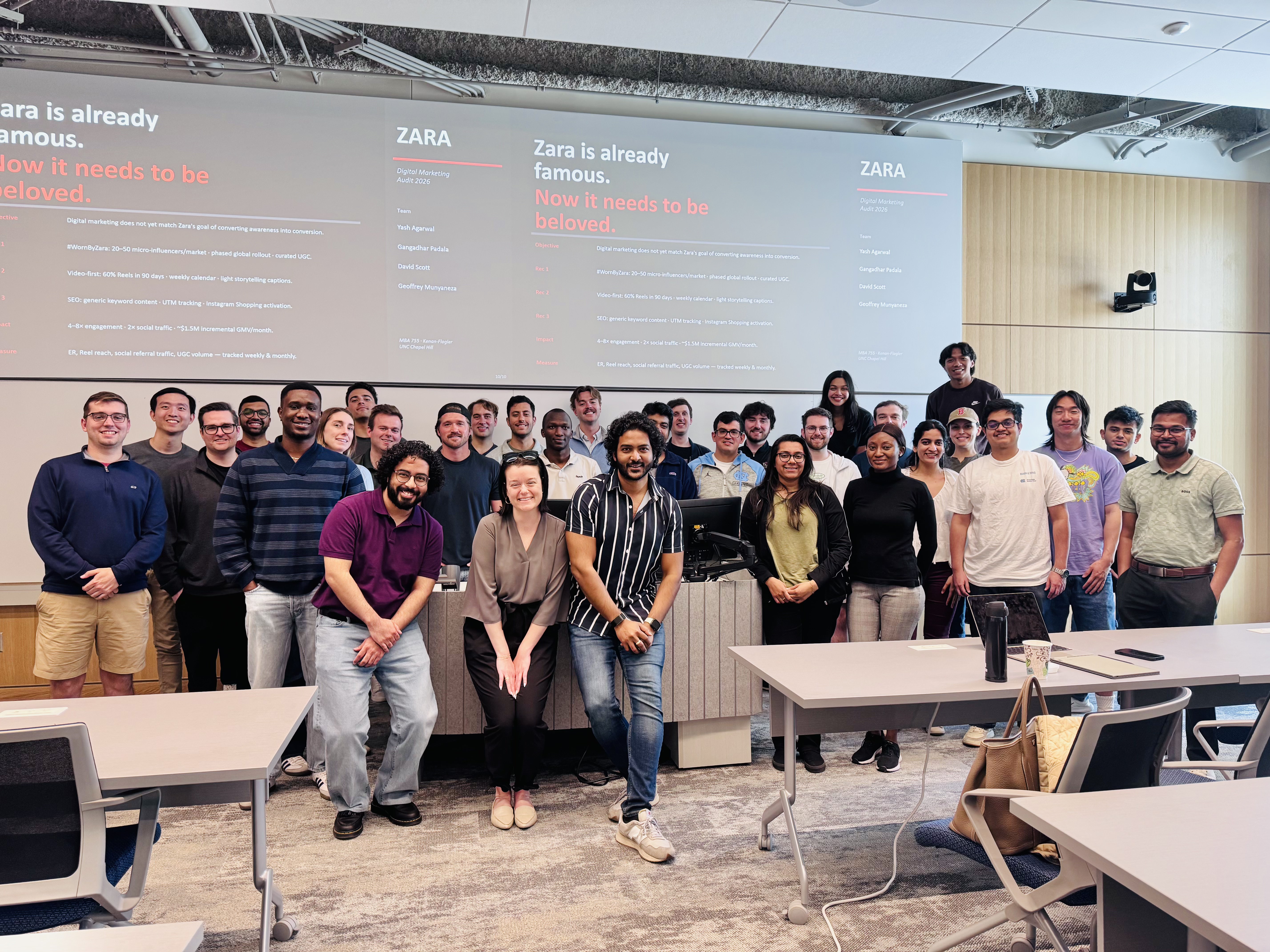
A course team presentation at Kenan-Flagler, with the classmates I worked with on it. Much of the bridge was practice at moving an argument between audiences.
Summer 2025EssilorLuxotticaInside the bridge
Twelve weeks in Dallas, two workstreams: diagnosis, then a proof of concept.
A hypothesis-led diagnosis of where operational escalations originate across the purchase-to-delivery workflow, and a returns and delivery-risk proof of concept built with three data scientists.
Twelve weeks in Dallas across two workstreams. The first was a hypothesis-led diagnosis of where operational escalations originate across the purchase-to-delivery workflow, and recommendations involving SLA triggers, standard operating procedures, and data architecture.
The second was a returns and delivery-risk proof of concept proposed by Teja and developed with three data scientists based at the Paris headquarters using Databricks ML on Azure. It demonstrated value on one B2B-vendor use case and informed a broader rollout initiated afterward.
A proof of concept, not a deployment.
2025–nowInside a fund
An internal research need became a product.
The fund had a long list of prospective investors and no dependable way to decide who deserved attention first. Building that ranking workflow became the Investor Intelligence Platform.
In August 2025 I joined the investment team at Excelerate Health Ventures, a seed and Series A fund investing in B2B pharma tech. I spent a year there and continue to work with them part-time.
Alongside investment research, an internal workflow need became a product. The fund had a long list of prospective investors and no dependable way to decide who deserved attention first, and building that ranking workflow became the Investor Intelligence Platform.
Research and building start happening in the same week.
2026–nowBuilding
Four builds, one shape: evidence trapped in a form that makes the next decision harder.
Four builds now carry that accumulated experience into different domains: household bills, model selection, investor intelligence, and LLM evaluation. They share a common shape: important evidence trapped in a form that makes the next decision harder.
I am also developing Profoundly, an interview series about how AI changes people's work, judgment, identity, and direction.
All tracks arrive here.
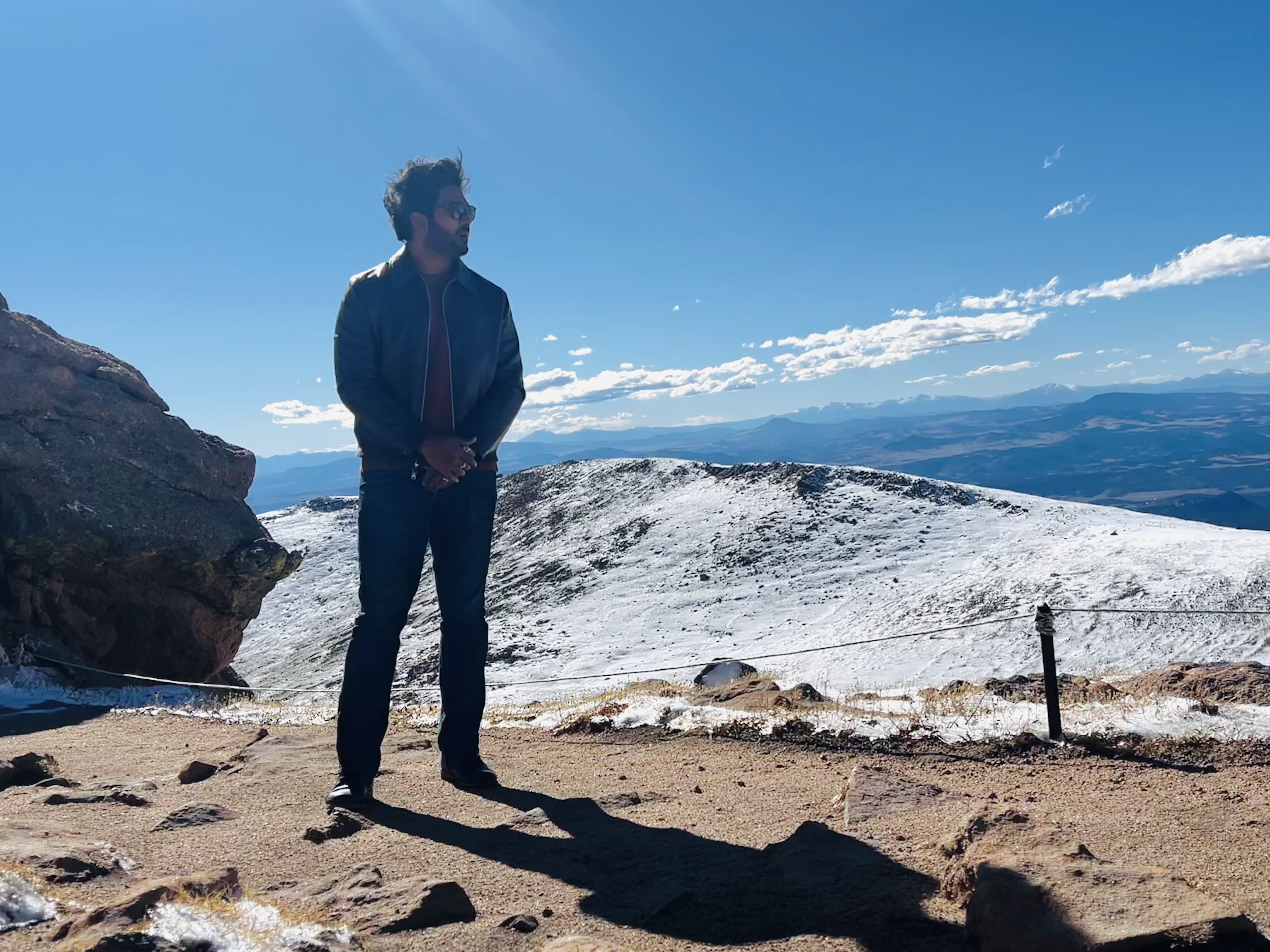
Denver, and the reason the mountains keep showing up.
Convergence
I want to bring this combination of systems thinking, product judgment, and hands-on building into a team working on consequential AI products.
The problems that hold my attention are the ones where models shape meaningful decisions, where the evidence behind an output stays inspectable, where technical and product tradeoffs are genuinely in tension, and where being honest about uncertainty makes the product better rather than weaker.
That is the work I am best equipped for, and the work I want to keep doing.
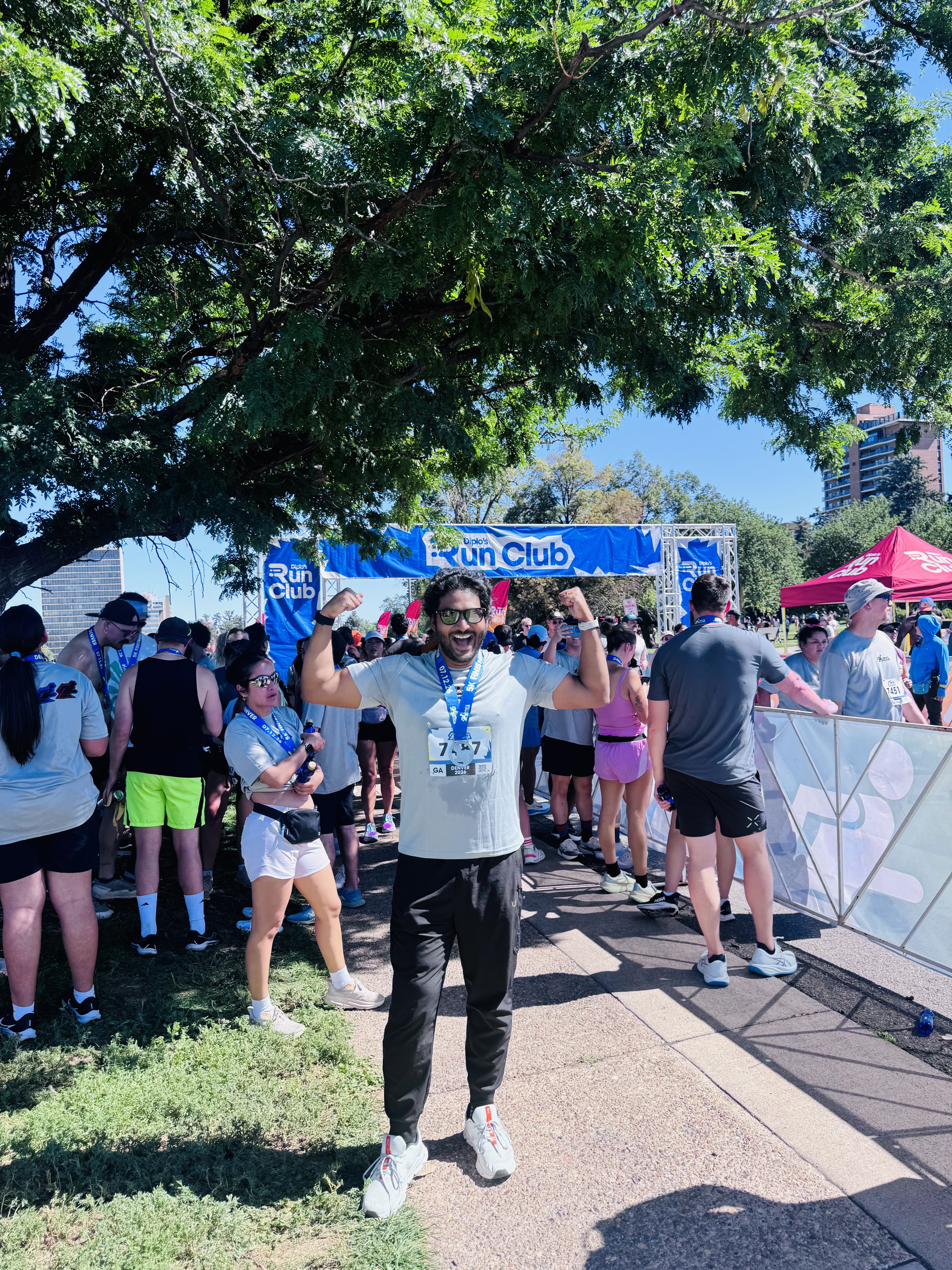
Denver is where the running, the mountains, and the building all happen in the same week.
{{ activeSpan }}{{ activeLabel }}
Timeline anatomy
One chronology, four tracks, honest overlap.
Persistent rail (desktop)
Thirteen rows, one per entry in the chronology data — the nine career and chapter spans plus all four degrees — fixed at mid-viewport left. An amber fill tracks scroll position through the whole chronology; a cyan pulse gives the rail life at rest. Degrees and concurrent chapters are indented off the spine in green rather than inserted into the career sequence.
Active-span logic
Every milestone carries a named anchor id. The active row is the last anchor above 50% of the viewport whose id exists in the chronology data — no index arithmetic, so inserting a degree cannot misalign the rail. The opening is its own explicit state. Upward scroll reverses by the same rule instead of undoing a triggered animation.
Concurrency
Employment, founder, education, and product/venture are separate lanes on a 2017–2027 axis. Bars are positioned from dated facts, so overlap is drawn, not implied. The 2021 master's is a point marker because only its completion date is known.
Mobile chronology
The rail is replaced, not shrunk: a sticky current-era bar with a 2px progress line, and a 48px-row expandable chronology sheet that jumps to any span.
Motion inventory
Ambient at rest: rail pulse, present-day marker breath, hero portrait micro-scale. Three layers, no more.
Scroll-authored: rail fill, clause sweep, five image apertures, lane bars, convergence lines.
Everything is computed from element position each frame, so reverse scroll is exact.
The loop stops on tab hide and skips elements outside the viewport band.
Crop and focal-point inspector
Every crop keeps its subject.
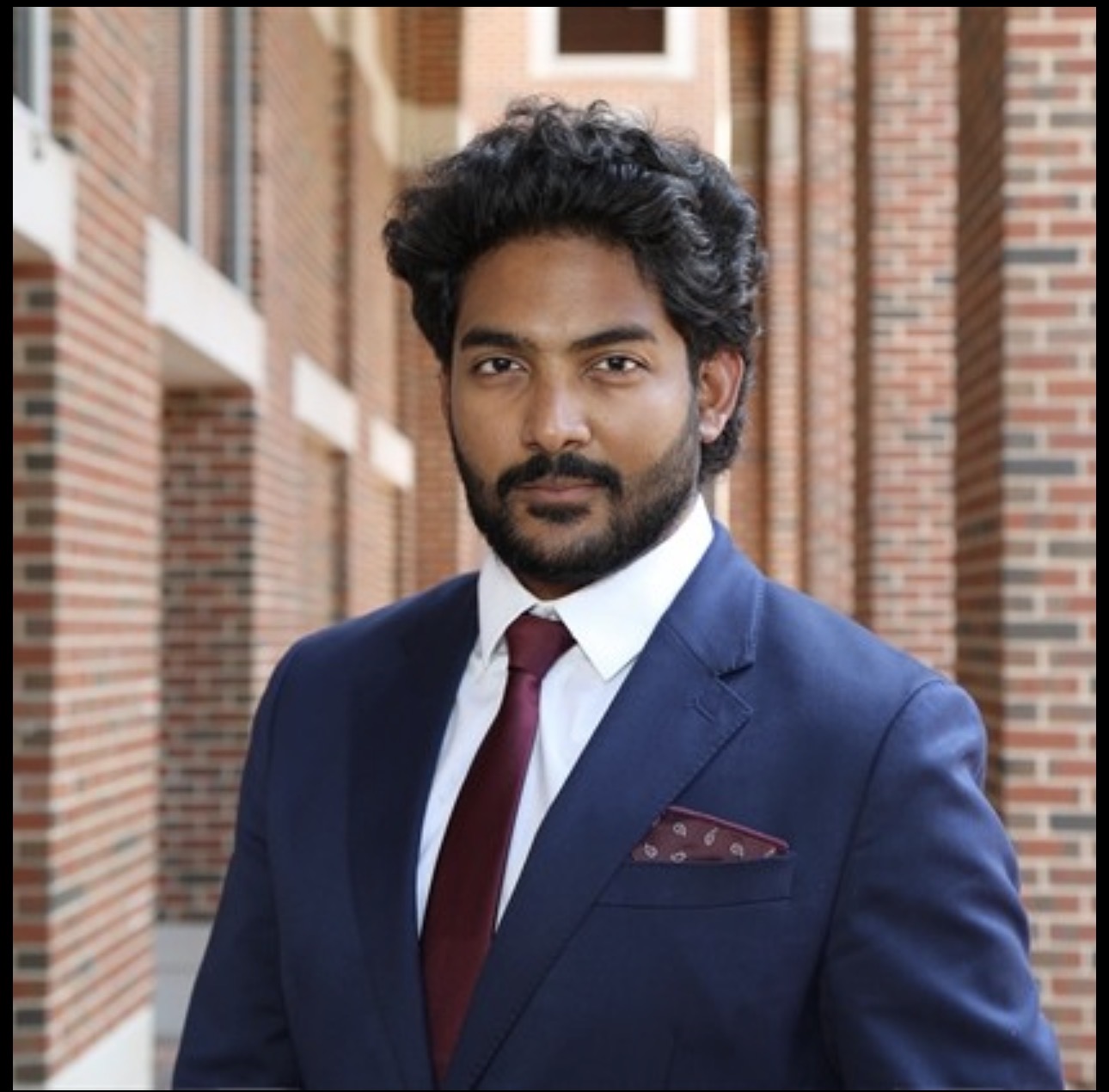
01 · 1290×1270 · frame 1:1, focal 50% / 42%. Near-square source kept near-square; no 4:5 narrowing. Entry: centre aperture.
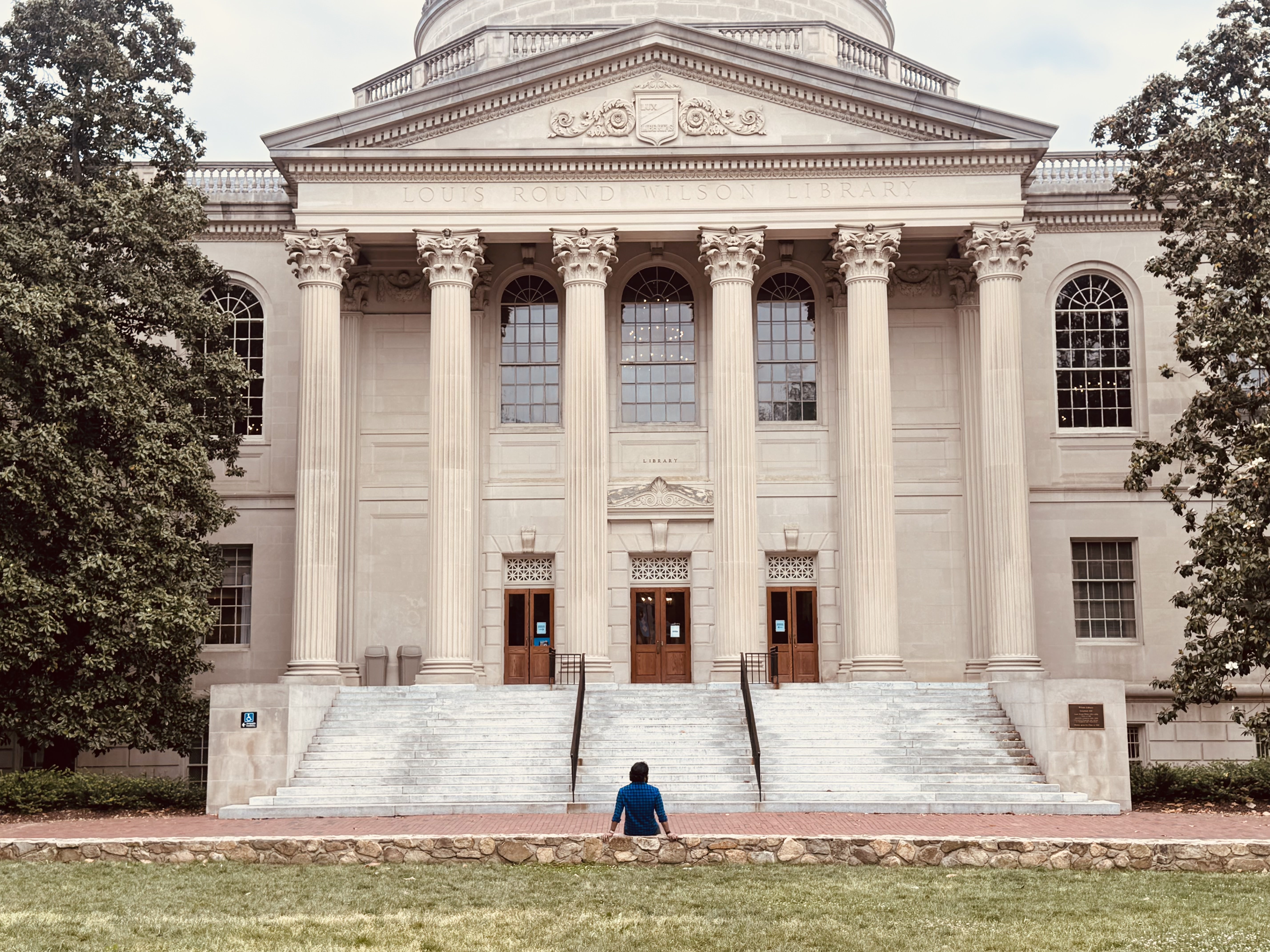
06 · 5712×4284 · displayed contained, zero crop. The person-to-building scale is the content, so nothing is cut. Entry: curtain wipe.
04 · 4284×5712 · frame 3:4, focal 50% / 62%. Raised arms and legs both inside frame; bottom not cut. Entry: reveals upward from the ground.
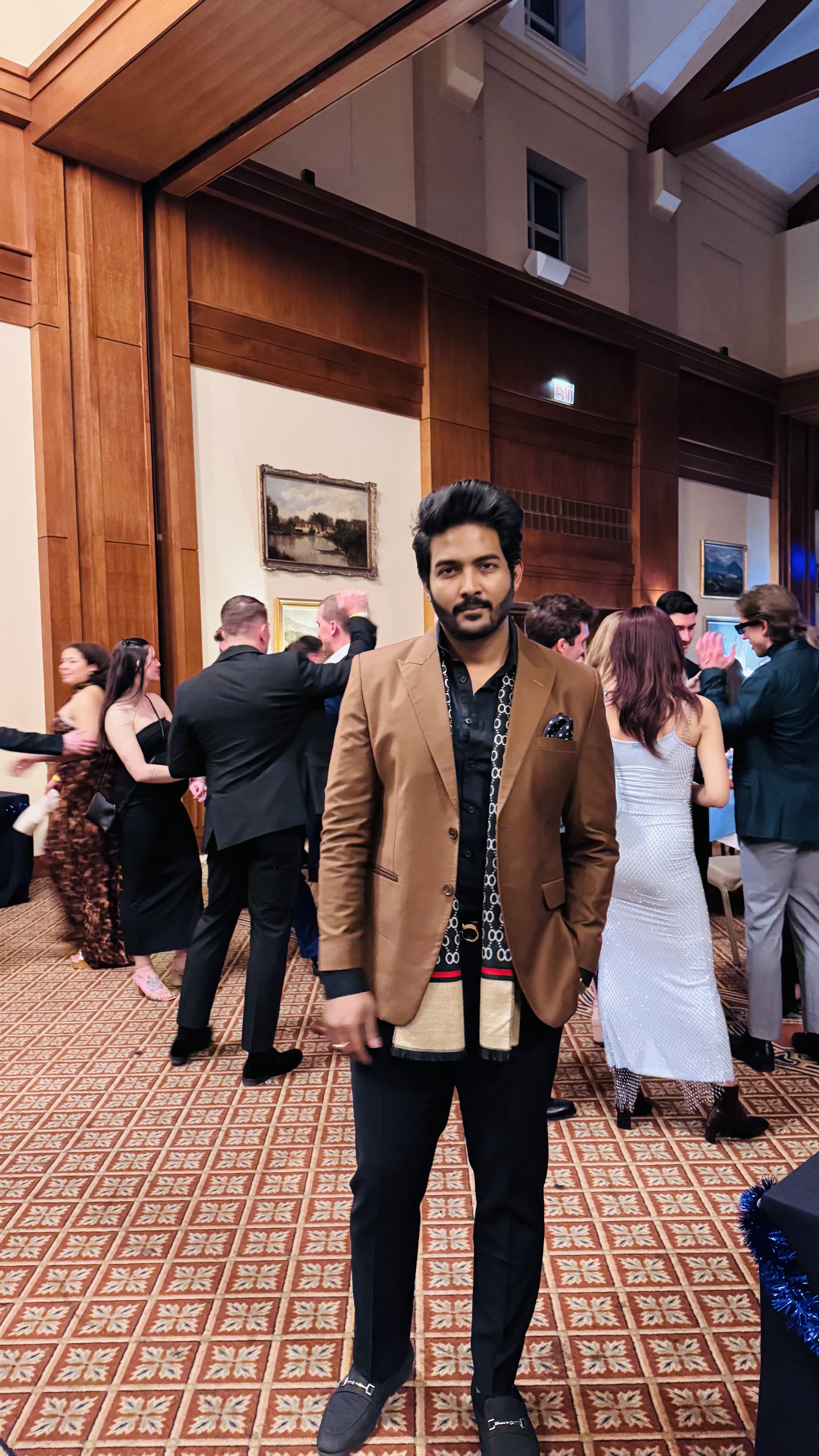
02 · 3213×5712 · native ratio kept, focal 50% / 30%. Head and body whole. Entry: image slides inside a fixed aperture.
05 · 4032×3024 · band recomposed in V2.1.1. Stated accurately: the 4:3 source is cropped vertically on wide desktop apertures — a 420px band across the desktop column shows roughly 55–65% of the frame height at 1440 and 1280, so the vertical crop is real. What keeps the subject safe is the constrained focal range (object-position Y 10% → 6% only) together with the top-origin reveal, which hold Teja's full head inside the visible band at reveal entry, reveal midpoint, settled state and reverse-scroll midpoint, at 1280 and 1440, and at 390×844 where the 260px band is very nearly uncropped. V2's 44% → 53% drift cut the head and was rejected.
07 · promoted in V2.1 · min(560px, 45vw) desktop, full content width mobile, object-fit contain so the whole 4:3 group survives, curtain reveal, caption below · truthful collaboration caption, never dominant.
One responsive moment, two sources
08 wide · desktop only · 4:3 aperture opening from a centre horizon band.
09 vertical · mobile only · 3:4 aperture, same beat. Never adjacent to 08 in the journey.
03 relaxed portrait is held out: the coda already has a human lead and a second portrait would turn it into a gallery.
Reading depth
Scan, story, full detail — same era, three depths.
Depth 1 and 2 are always visible. Depth 3 opens from a 44px button and is reachable by keyboard on every device. No fact lives only in a hover state.
1 · Scan2017–2022 · Regulated systems
Five and a half years where everything built had to be explainable later.
≈ 6 seconds. Recruiter-speed read.
2 · Story
Most of that work was on AWS, much of it on the data mart team. The organization ran machine learning. I was not building models. I was helping build the data foundation beneath them.
Always on screen, under the scan line.
3 · Full detail
In April 2017 I joined Hexaware Technologies and was placed on the Fannie Mae account, where I spent five and a half years as a software technology consultant. Hexaware was my employer; Fannie Mae was the environment I worked in… plus the ETL and 2021 master's paragraphs in full.
Opens in place. Verbatim canonical copy, nothing paraphrased upward.
Interface sentences I wrote (not in the canonical copy)
“Civil engineering taught me to read systems. Engineering management opened the path into software.”
“Five and a half years where everything built had to be explainable later.”
“A consulting company built alongside the full-time role. $1.8M revenue by 2024.”
“Twelve weeks in Dallas, two workstreams: diagnosis, then a proof of concept.”
“An internal research need became a product.”
“Two tracks, one period — then they converge.” and the four lane labels.
“Denver is where the running, the mountains, and the building all happen in the same week.”
Contact invitations for product work and Profoundly, and the short track notes beside each era.
Each is a compression of supplied copy. None adds a metric, a client name, a deployment claim, or a date that is not in the source.
Rejected patterns
Seven treatments considered and refused.
Static editorial article
Reads well at leisure, tells a recruiter nothing in 60 seconds, and cannot show that two tracks ran at once.
787-word paragraph wall
The canonical copy is the authority, not the layout. Printing it in one reading path breaks the 120-word viewport gate.
Generic card grid
Equal cards flatten chronology into a menu. Nothing accumulates, nothing overlaps, nothing converges.
Hobbies gallery
Nine photographs as a mosaic turns evidence into decoration. The coda keeps three, each doing a job.
2014 2017 2021 2024 2026
Desktop rail squeezed onto mobile
6px labels and 20px targets. Replaced with a sticky era bar and a 48px-row chronology sheet.
Face-cutting hero crop
A fashionable narrow band across the portrait removes the person. Every frame in the journey keeps its subject whole.
Uniform fade-up reveals
One easing applied to everything says nothing about the content. Each image entry here is chosen for its narrative role.
Profoundly explores how people are using AI to work, think, and build differently—and how that experience changes what they believe is possible.
What happens when AI changes not only how someone works, but the decisions they can make, the role they can play, and the direction their life can take?
Much of the AI conversation centers on the people building the technology. Profoundly turns toward the people putting it to work in real life.
The common thread is not AI expertise. It is what AI made possible—and what changed because of it.
Conversation territories
These are places a conversation might travel—not categories every story must fit.
01
Pivots and identity
What changed in your direction—and what did that change in you?
02
AI outside software
What becomes possible when AI reaches work the technology conversation usually overlooks?
03
The second brain
When does assistance become part of how you think?
04
Open, closed, and everything between
What should remain visible, and what are we willing to trust behind the interface?
05
Judgment and power
What should the machine never get to decide?
These are examples, not boundaries.
Each conversation offers a new perspective, something practical to carry forward, and a clearer understanding of where human judgment still matters.
What a conversation leaves behind
What a conversation leaves behind
Teja Padala · AI product builder and host of Profoundly
Thoughtful conversations, researched carefully and interested in the parts that resist easy conclusions.
If AI has materially expanded what you can do—and changed how you work, think, build, or see your own direction—I would like to hear the real story.